Partnership · Delivery
Choosing an AI implementation partner
What a business should expect from an AI implementation partner: diagnosis, scoped pilot, integration, human controls and ongoing review.
The short answer
Start with the work
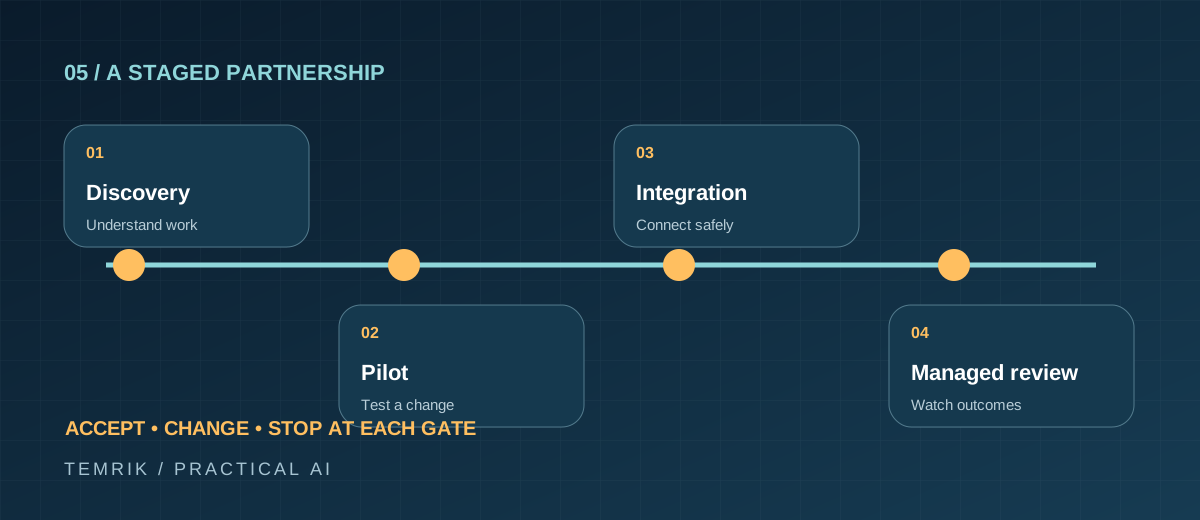
Choose a partner who can explain the workflow, the owner, the data boundary, the evidence needed for success and who will maintain it. Agree each stage and its acceptance criteria before expanding from a prototype to operation.
01 / Guide
Ask for a clear first diagnosis
A useful partner begins with the current workflow, users, systems, pain and baseline. Ask them to identify where AI is suitable and where simpler process change or existing software is better. Request a written scope that names deliverables, excluded actions, dependencies, data access and responsible people.
TEMRIK describes itself as an agency for agents: human-led help to identify work, test suitable tools and connect governed workflows. Its public property demonstrations are entry points for conversation; they are not proof of a fully deployed solution for every industry.
- Identify the business outcome and current baseline.
- Agree a bounded pilot with permitted data and human decisions.
- Require a documented acceptance test and handover owner.
02 / Guide
Separate prototype, integration and operation
A prototype tests feasibility. Integration requires permission design, source quality, error handling, fallback and user acceptance. Ongoing operation adds monitoring, support, version review and a way to stop or change the system. Ask what exists today, what is a demo and what must still be built for your organisation.
Set service and commercial expectations separately: scope, price, ownership, support and exit arrangements should be agreed before paid work. Avoid treating a positive pilot as permission for autonomous production actions.
03 / Guide
Review the partnership by outcomes
Hold a regular review of completed work, human corrections, exceptions, cost and user feedback. Keep the task set and evidence portable so tools can change as the market changes. The partner should make ownership clearer over time, not make the business dependent on an unexplained black box.
Worked example · illustrative
Example: a property agency starts small
- Situation
- An agency wants a more consistent response to maintenance enquiries.
- Test
- A partner maps current intake, demonstrates a proposed triage flow and pilots classification with human review on approved examples. Integration with live systems is separately scoped and tested.
- Decision
- The agency accepts further work only after reviewing accuracy, workload, data access and staff feedback. The scenario illustrates a possible engagement, not an existing customer outcome.
Measurement
What to record
Agree a baseline and compare the same categories after the test. Define a minimum acceptable result before seeing the output.
- Named owner and accepted deliverables at each stage
- Full workflow time and correction burden
- Exceptions with a clear human decision
- Support effort and ability to change provider or stop
Further reading
Primary sources
These external sources inform the general guidance. The worked examples and recommendations above are TEMRIK’s own.
- UK Government: AI Management Essentials guidance (opens in a new tab)Organisational processes behind responsible AI use.
- Australian Government: Artificial intelligence for business (opens in a new tab)Business guidance on introducing and documenting AI systems.
Work and partner with TEMRIK
Turn a useful idea into a controlled test.
We can discuss your workflow, prepare a scoped pilot and agree what would make a wider implementation worthwhile. Bring a partner opportunity or a business problem; scope and price are agreed before paid work.